

Danny Brown has been obsessed with his own age for the last fifteen years. His debut album (“eighth mixtape”) XXX hit the internet music blogs like an atomic bomb in 2011, and while I love the whole thing, the most profound song on the album is “30,” the last track on the album. It’s about turning 30 and being totally washed as a rapper and hoping that this one last effort saves him from going back to prison. The album all leads up to this point: the first and title track is a kind of thesis statement about how the album will be XXX because of the explicit nature of the material he’s going to describe (drug abuse, suicide, rape, poverty), and then in the next 17 tracks he details all of the problems he inherited from growing up in an abandoned Detroit and then going to prison for crimes he felt compelled to commit to survive, and then the XXX rating becomes the 30 years of his life he’s suffered through to become who he is. Rap saves his life, but he has no hope that it will actually save his life, because nothing else has.
I listened to XXX on Bandcamp about 100 times that fall and read reviews ravenously. I’d just graduated college and had no money and wasn’t seeing any live music. I always skipped the two songs with his Detroit friends (“Bruiser Brigade” and “Detroit187”) in the middle of the album because they’re bad features and the content of the songs is totally gross, but “30” and “DNA” and “Scrap or Die” and “Die Like a Rockstar” are imprinted on the back of my brain like few other rap songs from the last 15 years.
XXX was popular enough to fund Old, his next album and his most successful and ambitious project. Old is one of the best rap albums of the 2010s. The lyrics are as smart and funny as XXX, but the production feels much more expensive and the album’s side A (songs about trauma) and side B (songs about partying to forget trauma) structure feel much more like an indie rock album than a rap album. Most of the features are much better than on XXX, especially from a young Freddie Gibbs (good investment) and Charli XCX (um, very good investment). The album’s two skips (for me) are the songs with Top Dawg artists Schoolboy Q and Ab-Soul, who were always overrated and who don’t add anything interesting.
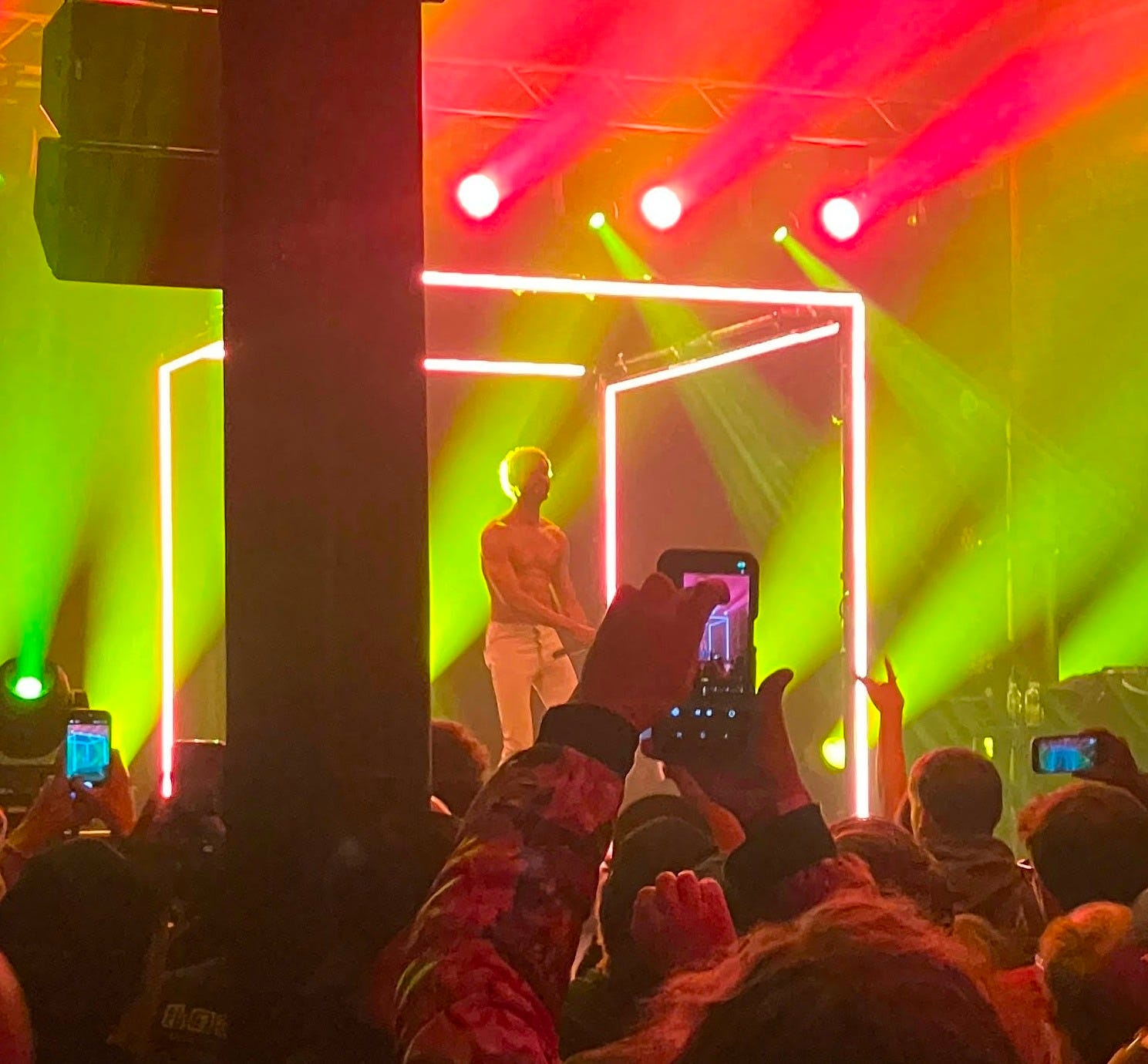
While Danny’s Brown show last Friday was only about half as full as Joyce Manor’s weekday one the previous week, the crowd was equally as engaged:
You can’t quite see it there, but a solid 10 foot diameter, sometimes widening (for the Old track “Dip” about the joys of MDMA) and sometimes contracting (for the bizarre and wonderful “Scaring the Hoes” from his 2023 collaborative album Scaring the Hoes) mosh pit was also cheering Danny on. You also can’t quite see it there, but 15 years after his debut, he’s never looked so ripped:
The show started at 8:30pm and ended at 9:30pm. In that hour he played around 20 songs. At least 6-8 of them were from Stardust, his album from last year. One was from Scaring the Hoes, 0 were from Quaranta, his other album from 2023, about being too old (at 40) to continue to perform rap music. One song was from 2019’s uknowhatI’msayin?, while three were from 2016’s Atrocity Exhibition. Finally, Brown played four songs from Old and two from XXX.
In spending the last couple of weeks listening back to Brown’s catalog, I realized that I was wrong when I said that “there’s no thematic through line ” for Stardust earlier this year. I understood all the other albums just like Danny does: everyone can forget about Quaranta and uknowhatI’msayin?, Scaring the Hoes is cool but weird, and his first three albums are full of classics. But Stardust is simply about joy: he’s happy to be sober and making a big pop album full of jams. These songs are simply fun to hear on giant speakers with a crowd full of people who all get to go home early because Danny’s focusing on working out and getting lots of sleep and keeping his voice in tip-top shape so he can rap his ass off for an hour straight to his Midwestern fans. If I could love Side B of Old because he’d earned it with the trauma storytelling of Side A, I could love Stardust because it’s extremely competent, because Brown is a master of rhythm and texture and the album sounds great on headphones when I’m playing videogames.
Danny Brown is young now. I’m not quite on his side of 40, but I’m close enough to drink way less now than I used to, to work out more, to focus on getting good sleep and writing more because it’s something I love and I want to get better at it. He regrets being a bad parent; I’m going to do my best to be a good one.
I ran into a guy at the concert who I’d always liked, a neighbor who I referred to the daycare that my kids go to. He’s always seemed like a cool guy: turns out he also loves Danny Brown! We talked about seeing him in the past: I’d seen him twice, he’d seen him once. We hadn’t realized how unhealthy Brown had been until we were seeing him now. There’s always glamor in sinking into depression and drugs, but that sinking into can also just be boring. The story of musicians getting sober and becoming boring (Jason Isbell, Isaac Brock) neglects the story of musicians that never get sober and just die.
The only pause that Danny Brown took was before his last song, “All For You.” The song is about how his fans kept him alive. It’s one of his simplest songs, soundtracked by a typically insane, stuttering vocal sample from my beloved Jane Remover. Before the song, he almost nervously dedicated the whole show to his fans. His show had been a physically and vocally demanding berserk, a chronicle of how a rapper can stay relevant for two decades (an incredibly rare feat). He stood there and quickly explained how he’d almost died, how he needed us, how he was grateful to be there. This was the same man who’d sang odes to cunnilingus and MDMA 50 minutes earlier, but there was no irony here: Danny Brown was old, and he is young, and I’ll definitely see him again when he comes back to his Midwestern home.