

I started writing about Goethe’s Faust yesterday because I realized it was the most substantial piece of fiction I’d read in the last three months, and I was going to add a review of it to a “Quarter 2 Fiction” roundup this week. I’m reading it with a friend of mine, and he’d prompted me to read some Carl Jung and Andrea Wulf’s The Invention of Nature as supplements.
However, the review soon got completely out of hand, just like Faust’s adventures with Mephisto in the book. I present my completely unhinged take on the book below where I reflect on the ways that Faust/Goethe are similar to Al Green, and I’ll add this take to my Quarter 2 Fiction roundup next week when I get that done.
(Much of the Al Green material is inspired by Evil Speakers’ series on his records, especially his episode on The Lord Will Make a Way)
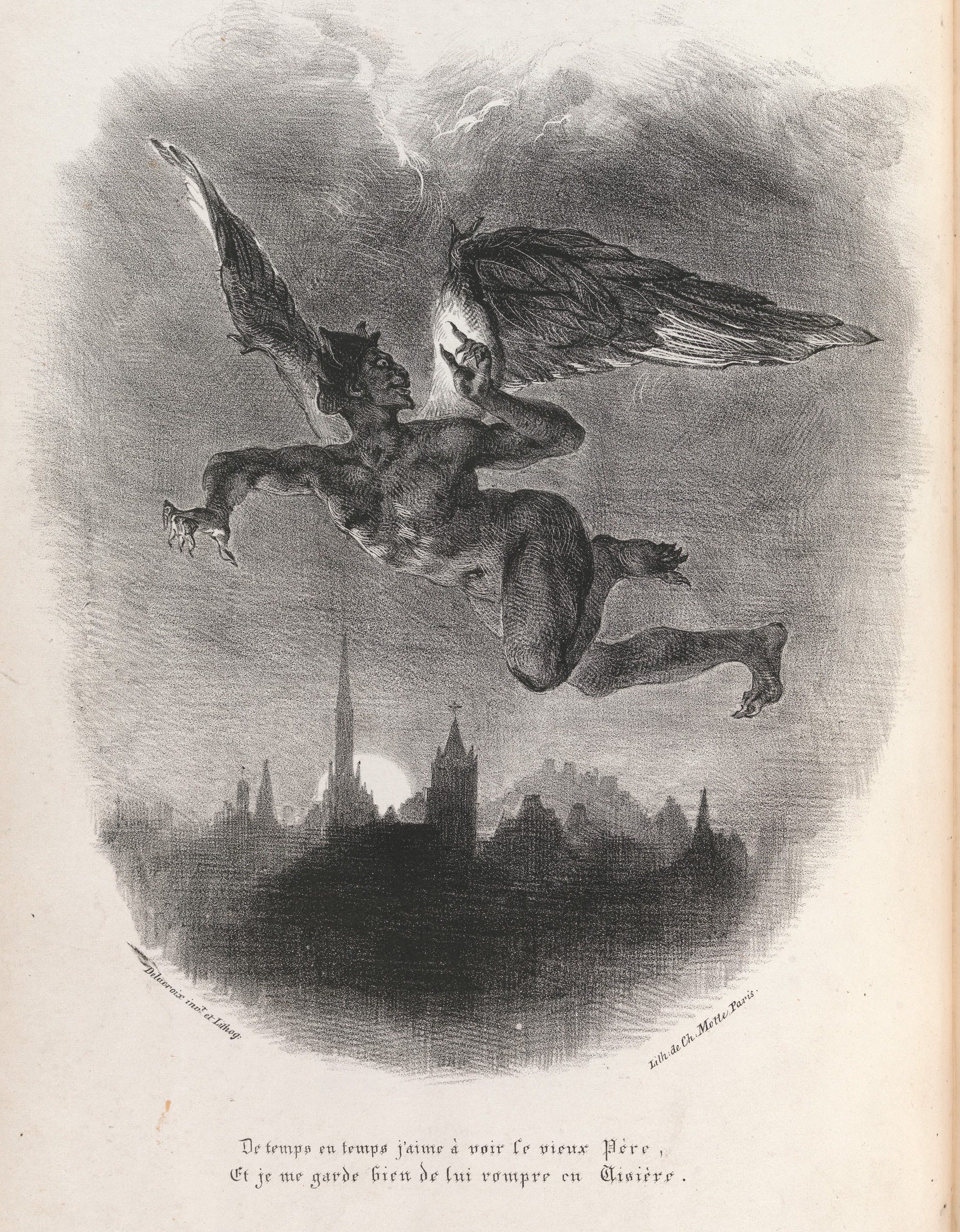
An Analogy
Al Green’s Greatest Hits is Goethe’s Faust, Part One. Like Goethe in 1808, Al Green is at the peak of his powers in the 1970’s. He didn’t invent soul music (that would be Charles, Redding, Gaye, and Franklin) but he perfected the package: efficient 2-3 minute paeans to sex and human devotion produced and sang as if they were paeans to God in the tradition of a church that was nearly hundred years old and had sustained a culture through some of the most profound horrors in modern history. Goethe didn’t invent the forms he’s using but he cuts all of the fat off of the dramatic tradition stretching from the last Middle Ages through the English Renaissance in Faust, Part One. It’s got echoes of Dante’s Comedy (at one point he borrows Dante’s rhyme scheme), or Milton’s Paradise Lost…but it’s much shorter and snappier. It’s much easier to understand and be entertained by the first time than most of Shakespeare’s plays, but it’s just as brutal as Macbeth and just as funny as Midsummer Night’s Dream. It’s an insanely entertaining depiction of ambition, evil, and pure poetic invention. As translator Walter Kaufman says in his introduction:
A long poem is almost a contradiction in terms...In modern literature, one finds time and again how a line or brief passage of great beauty is followed by what is essentially prose: ‘sapphires in the mud.’ In Faust the poetic peaks are also surrounded by what is, lyrically, flat land; but what helps to make the poem one of the greatest of world literature is that Goethe’s...unique range of perception, sensitive alike to nature and psychology, his surpassing wisdom, and his uncontainable sense of humor permit him to mount his gems in gold.
Faust is your prototypical talented, amoral artist, frustrated with the limitations of science. Mephisto is the “true” star of the play, providing an ironic (since he’s the Devil) conscience to Faust’s continual grasping for pleasure and power. ven the insane Walpurgis Night section was leavened by dick jokes and high Romantic German mountains and Kaufman’s always-readable notes.
I don’t read German, but Rebecca does (it’s a been a while since she’s used it), and in Part One, I found myself checking in with her every few pages, because Kaufman shows his work in this translation and gives the German side-by-side with the English. She’d tell me, yeah, what he’s saying in German is the same. Nearly every time, Kaufman would get not only the rhythm and rhyme but nearly the exact meaning across of Goethe’s original work.
As Faust, Part One wraps up with the lonely death of a woman that he had seduced, impregnated, and then abandoned (so he could go climb a mountain with Mephisto and participate in Walpurgis Night), you hate Faust’s callousness…but it’s obvious that you’re supposed to. And as Al Green’s career post Greatest Hits starts to wrap up in the 70’s, you see, like Faust, that he’s leaving quite a trail of destruction in his wake. And (not right after, but soon), both Green and Goethe will start to make very different art that they did in their Greatest Hits periods.
From “Ex‐Companion Scalds Singer, Then Kills Herself,” New York Times, October 19, 1974
A former girl friend dumped a pan of scalding grits on Al Green, a popular singer, today as he was getting out of the bathtub and then apparently shot herself to death.
Although the police were continuing to investigate the shooting of 29‐year‐old Mary Woodson of Madison, N.J., Inspector Dan Jones said, “It looks like suicide.”
Mr. Jones said that the authorities had found a three‐page suicide note, addressed to Mr. Green, in the victim’s purse. The inspector said it was written on stationery from the motel where Mrs. Woodson was staying.
The police said the shooting occurred at Mr. Green’s home near Memphis. The 27‐year‐old singer who records for the Hi Recording Company and has cut five consecutive hit songs, was hospitalized with second‐degree burns on his back, arm and stomach. A hospital spokesman said the burns were serious, but not critical…
Mr. Green, originally from Arkansas, joined the Memphis-based Hi Recording in 1971. Since then more than 20 million copies of his records have been sold. His five consecutive hits are “Tired of Being Alone,” “Call Me,” “Let’s Stay Together,” “You Ought to Be With Me” and “I’m Still in Love With You.”
Last summer Mr. Green was charged with assault and battery on the basis of a complaint filed by a former secretary, Linda Wills, 25, now of Washington. The charge was dismissed on Aug. 27 by a City Court judge because of conflicting testimony.
Faust Part One, Translated by Walter Kaufman, from “Wood and Cave,” (lines 3220-3254)
Faust (alone):
Exalted spirit, all you gave me, all
That I have asked. And it was not in vain
That amid flames you turned your face toward me.
You gave me royal nature as my own dominion,
Strength to experience her, enjoy her. Not
The cold amazement of a visit only
You granted me, but let me penetrate
Into her heart as a into a close friend's.
...
Alas, that man is granted nothing perfect
I now experience. With this happiness
Which brings me close and closer to the gods...
He kindles in my breast a savage fire
And keeps me thirsting after that fair image.
Thus I reel from desire to enjoyment,
And in enjoyment languish for desire.
Mephisto (enters):
Have you not led this life quite long enough?
How can it keep amusing you?
It may be well for once to try such stuff
But then one turns to something new.
Faust:
I wish that you had more to do
And would not come to pester me.
Mephisto:
All right. I gladly say adieu---
You should not say that seriously...
The Gospel Era
Goethe started writing Faust Part Two shortly after he’d published Part One, and he simply never finished it. He got distracted with other projects, he got really into science (this is explained in Wulf’s book), and he probably got too famous (though he never had his own hot grits incident). When the book eventually came out, it was a huge success in Germany, just like Part One, but it’s never been as much of a success in the literary world as Part One, due to, well, Kaufman explains it best:
For the translator, who must dwell carefully on every line, Part Two contains enormous lengths, and what lies between the first scene and the last act is not altogether tempting. To let Goethe speak English is one thing; to transpose into English his attempt to imitate Greek poetry in German is another. Those who wish to study Part Two but but have no German should find the Victorian archaisms of existing English version one of the less obstacles.
At many, many points in Part Two, and even in Part One, I thought: Johann, you can just pause a second and develop this character. But that’s Goethe’s strength, too: he’s confident enough in his poetry and his interests that he doesn’t make the audience sit through some staged interaction to give Faust some interiority that he doesn’t have. Faust doesn’t sit and think; that’s his problem. Mephisto plans and plots; that’s his problem.
After “the grits incident” Al Green had an conversion experience late at night in Disney World, and began to slowly but surely turn his soul music into gospel. He didn’t make the change all at once, but by 1978’s Truth and Time, he’d stopped making love songs about sex and started making them about God. The fabulous documentary The Gospel According to Al Green doesn’t need to explain his conversion experience; it simply embodies it in the never-release track “Love You” that opens the film. Check it out”
In the case of Green I’ve been slowly (about an album a week on average) listening to his entire catalog this spring, and on arriving at his gospel material in the 1980’s, I’ve enjoyed it much, more than I thought I would.
For example, “Pass Me Not” is as good as Green’s best 1970’s material. That rhythm section! Those funk guitars! And Green’s voice: sure, he’s not trying to seduce you any more, but his “humble cry” towards his “savior” is at least as thrilling, even if you’re a stone-cold atheist (like me).
It’s not quite as good as a lot of Bob Dylan’s 1980’s material (when he was in his own Christian phase), though I just prefer Dylan to Green in general, so that’s not totally fair. But like Dylan, if Green had tried to keep remaking his greatest 1970’s material in the 1980’s, he would have obviously failed. A noble failure is better than a mediocre one.
However, let me be your Kaufman, and say: a lot of this material is like Green imitating Greek poetry in German. It’s only for the weirdos.
Maybe I will, one day, get deep enough into Goethe to want to read parts of Part II that Kaufman cut out of the version I read, but I suspect at least some of those parts will be as incomprehensible as “Highway to Heaven,” a totally bizarre country-tinged gospel song featuring an insistent(ly annoying) rock beat and a children’s choir.
However, the fight between the angels of Heaven and Mephisto over Faust’s soul at the end of Part Two is some of the most thrilling and beautiful poetic drama out there. Mephisto summons various demons; a divine Feminine summons a choir of schoolboy angels (who turn out to be babies who died at birth); they battle it out in a phantasmoric pit of fire with divine flowers that turn into weapons; I mean, c’mon, this is just some utterly cool shit. It’s “Pass Me Not” with a 70-piece orchestra instead of a ludicrously well-produced funk band.
The ending of Part Two of Faust also reminded me of my guy Dante from earlier in this spring, and ultimately, I can recommend the whole Divine Comedy, not just the often-excerpted Inferno, because his obsessive structuring of every aspect of his poem allows the authentically surprising moments to spring forth a little bit more beautifully.
In real life, Al Green’s conversion to Reverend Al Green in the 1980’s did not doom his material to irrelevance: passing trends of pop music come for everyone, no matter how talented they are. I’m not really trying to convince you to read Goethe or listen to Al Green, and Goethe wasn’t trying to convince you to be a good person, or warn you against the dangers of ambition. He was just trying to express, like Al Dream in some psychedelic, seven-minute-long Dream, how it feels to be alive, through a play that he wrote through his entire life. Aren’t we all…