
On Fibre Fads and Moral Fiber
Checking in on the Canon #2: Goldfield/Mann/Gold

Part One: “The Fibre Fad” is what’s wrong with writing about food culture instead of food
My grandmother gifted me a subscription to the New Yorker around 2005 when I was in high school. In return, I call her every weekend.
I’ve never been and never will be a person who creates a stack of the magazine somewhere (the bathroom, the bedside table). I read all I want of it within a couple of days of receiving my copy and then I recycle it. There are parts of it that I rarely read (the fiction, the relentless stream of articles about AI) and never read (the poetry, not because I hate poetry but because I hate New Yorker poetry), but one part I always read is the restaurant reviews, which they’ve called “Tables for Two” for a long time.
I don’t live in New York, so it may seem strange that I care less about about some issue of national importance than a review of a place that I will likely never patronize; however, I’ve visited the titular city for a total of about five weeks over the course of the last 16 years, and I actually do remember back to old restaurant reviews that I enjoyed and plan my trips around them. Reviews of out of the way (nowhere near Manhattan or the northwestern neighborhoods of Brooklyn) places give me an excuse to ignore a typical New York itinerary when I visit. Yes, you should obviously visit the Museum Mile if you’ve never been to New York before; sure, you should hang out in Williamsburg and Greenpoint and Prospect Park, but what next?
What’s next is taking a public ferry from Brooklyn Bridge Park up the east river to Astoria, Queens and visiting the absurdly affecting Noguchi Museum (which I first heard about in an article about Ruth Asawa) as a kind of excuse to stop by the wonderfully strange Kabab Café (which I first heard about in a New Yorker restaurant review).
One of my favorite restaurant reviewers is Hannah Goldfield, whose review of al Badawi in 2022 led me to schlep Rebecca over to Cobble Hill from our downtown Brooklyn hotel nearly right after we’d arrived in New York on a Thursday for a Saturday wedding. We hadn’t eaten since breakfast and there were multiple places closer to the our hotel, but I knew that we had to go try msakhan for a bunch of reasons:
…The large, airy dining room, trimmed in charming if maximalist arrangements of faux flowers, was gently aglow….Platters of meat and rice steamed visibly, releasing a perfume of cardamom and cinnamon, and, behind a counter, a pair of bakers, smiling shyly, methodically pinched hunks off a huge mass of dough, kneading each into a shiny, smooth softball to be stretched out and baked in a giant tiled pizza oven.
In her cookbook “The Palestinian Table,” the writer Reem Kassis explains that the Arabic word tighmees translates roughly to “dipping” but refers to a “way of life for Palestinians”: “bread is like a utensil to scoop up food.” At al Badawi, every meal begins with a basket of warm pita, accompanied by slender, dense green olives, olive oil, and tangy, fragrant za’atar.
If you can keep yourself from tearing through the pita, thin and powdery, slightly crispy but perfectly pliant, before the food you actually ordered hits the table, it does make an optimal utensil. I scooped up excellent hummus and baba ghanoush; I scooped up luscious, golden deep-fried cauliflower (does any vegetable other than the potato respond so well to being plunged into hot oil?), in an appetizer called zahir, drizzled with a thick emulsion of tahini and pomegranate molasses, and in the zahr ma laban, a yogurt-based stew strewn with shaggy chunks of lamb. The dishes I most thrilled to, however, didn’t need pita—bread was efficiently incorporated into their elegantly self-contained blueprints. Much of the food of Palestine, and at al Badawi, overlaps with that of other Middle Eastern cuisines; the restaurant is co-owned by Abdul Elenani—who also owns a smaller Palestinian restaurant in Bay Ridge called Ayat (his wife, Ayat Masoud, develops recipes for both)—and Akram Nassir, the proprietor of the wonderful, long-standing Yemen Café, across the street. (Atlantic Avenue is sometimes referred to as Brooklyn’s “fertile crescent”; in the nineteen-forties, when the construction of the Battery Tunnel disrupted Manhattan’s Little Syria, some businesses moved across the river.) But “if there is one dish that is exclusively Palestinian,” Kassis writes, “it’s msakhan”—and if there’s one dish to order at al Badawi it’s this one. A round flatbread, doughier than pita, edges bubbled and charred and glossy with olive oil, is thickly layered with supple onions made bracingly tart and crimson from sumac, then crowned with half a bronze-skinned chicken and showered with slivered almonds and pine nuts…
We ate perfectly made pita to start, and then moved onto msakhan with utter abandon. I can picture Rebecca sitting under the carefully decorated sidewalk dining space right now, smiling next to an empty bread basket and a plate wiped completely clean of chicken and oil. Though the inside of the restaurant was as appealing as Goldfield had described, I enjoyed sitting outside and looking at the other Middle Eastern restaurants along Atlantic Avenue just as much. Over the cusp of the hill from the restaurant, you could sense the East River, just a few blocks away, and the skyline of Manhattan looming over it. We still had three more days in the city (including the day of the wedding) and Goldfield’s column had given us exactly the right start.
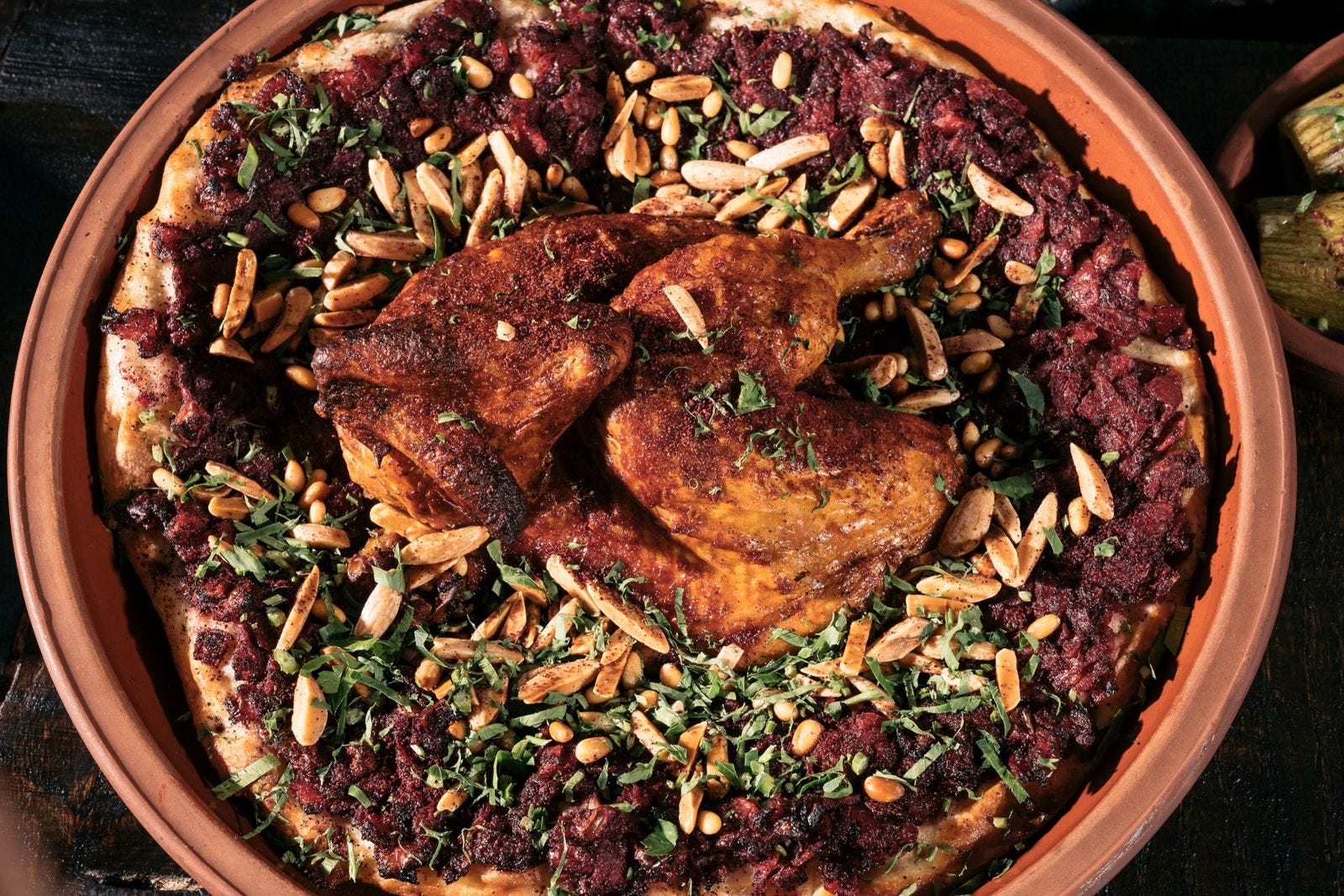
A great restaurant review takes the New Yorker off of its perch as the arbiter of middlebrow taste and plants it into the city where it putatively lives and forces it to pay attention to something small, and through the end of 2023, Goldfield just kept getting better and better at these profiles of neighborhoods and people through food, even crossing over into the no-man’s-land of Staten Island (a place I really like because I stayed at a friend’s there for a few days) or the far-north Washington Heights (near the Met Cloisters, which I also checked out during one trip). Her review of Seafood Kingz 2 from the Bronx makes me want to go to the only borough I’ve never visited and eat seafood and get pleasantly buzzed in the middle of the day:
When a friend heard, recently, that I was planning a trip to City Island, which is connected to the Pelham Bay section of the Bronx by a short bridge, he asked, “Are you going to Tony’s or to Johnny’s?” At the southern tip of City Island Avenue—the main thoroughfare, which runs the length of the narrow landmass, about a mile and a half—you’ll find two mid-century-era seafood restaurants, Johnny’s Reef and Tony’s Pier. With apologies to loyalists of either (Mike Bloomberg is a known Johnny’s guy), they’re nearly identical: both counter service, with a charmingly retro system of ordering that’s similar to the one at Katz’s Deli, featuring different stations (raw, steamed, broiled, fried, frozen tiki drinks), and both with ample outdoor picnic-table seating—beware of hungry gulls.
But in early 2024, Goldfield left New York. Based on her columns, she moved part-time (and then full-time) to Los Angeles. She had ascended to the ranks of culture writers, instead of being a mere reviewer. She stopped writing her “Tables for Two” column and started writing something called “On and Off the Menu,” which basically meant she was writing more about food culture all over the United States and would rarely review individual restaurants.
Her first column, about the joys of eating a passionfruit at Los Angeles’ own Gjelina and the search for a perfect passionfruit in New York, led me to order five pounds of delicious cherimoya from Rincon Tropics (they were out of passionfruit). I knew from my own visit to Gjelina (one of my friends used to live in Venice Beach) that it was actually as delicious (and absurdly precious) as she’d made it out to be in the article:
About a decade ago, a friend of mine and her husband moved from Brooklyn to Los Angeles. After landing at LAX, they went straight to Gjelina, a restaurant in Venice that exemplifies a certain image of life in Southern California: seasonal, sensual, wood-fired cooking; a sun-dappled patio near the beach. “We had this long, exquisite lunch,” she recalled recently. “And just as we were getting ready to pay the bill, feeling like ‘Wow, we’re Californians now!,’ something dropped out of the sky and landed in the middle of the table.” A passion fruit had fallen from one of the vines overhead, and as they sat there staring at it in delight a waiter appeared. “Wordlessly,” she said, “he cut the fruit into two hemispheres and handed each of us a tiny dessert spoon.”
Los Angeles (despite the stereotype) is probably easier for a New Yorker to understand than anywhere else in the U.S., because it’s a dense (not in the sense of actual density but simply of restaurants from all over the world, and when you’re visiting you obviously have a friend with a car who can drive you the lengths you need to go to eat in a far-off neighborhood), competitive environment for good food and is full of people who understand it.
When Rebecca and I visited my friend and his partner in L.A., we spent probably $80 on brunch at Gjelina, $60 on Korean BBQ in a strip mall for a late lunch, and $20 on dinner on al pastor cut right off of the trompo in a Home Depot parking lot. I can imagine Goldfield recommending a similar culinary experience, with perhaps a few more breaks for snacks, for a one-day trip to New York City.
When Goldfield has ventured outside of America’s two metropolises, as in her infuriating profile of the Minneapolis State Fair last summer, she’s done much less well.1 She somewhat made up for affronting the entire rest of the Midwest besides Minnesota by highlighting the actually underrated city of Omaha earlier this summer, but her monthly two-page dispatches in "On and Off” (as opposed to usually her usually weekly columns in “Tables”) can often feel more insubstantial despite being (at ~1700 words compared to ~800) twice as long. Absolutely no one should drink a mini-Martini,2 and Goldfield’s colleague is totally right (and Goldfield is wrong) about how the Grub Street Diet is basically a bored lady’s Instagram combined with celebrity spon-con.
The most disconcerting of these recent dispatches came out of the bowels of literal bowels. While Goldfield has thankfully never referred to protein in the sense of this ugly and obvious Atlantic article about beans as a superfood,

she has, unfortunately, now written about fiber, the other reason why beans are a superfood (I will object here to my own compounding of superfood; many foods are super, all superfoods are suspect). I’ll never read “One Food All Americans Can Agree On,” but I did read “The Fibre Fad Keeps On Moving,” though I wish I hadn’t. Just like Goldfield’s article about food diaries, it relies almost exclusively on social media for its sources, and there’s a curiously placeless and body-less quality of the writing despite it hypothetically being about food.
On social media, her posts skew aspirational, often showcasing the art of the dinner party: gingham tablecloths set with fresh flowers, kitschy cocktail glasses, and jewel-toned, vegetable-strewn platters. When she decided to experiment with high-fibre recipes on Instagram and TikTok, she opted for candor. In a video featuring roasted sweet potatoes with sautéed greens and dressed lentils, she spoke into a roll of toilet paper as if it were a microphone. “Welcome to Blow Outz,” she announced, in the self-consciously goofy tone of a game-show host, “a new series of recipes to knock a few things loose.”
…
Like so many trends, this one was pioneered by gay men: one of the early luminaries of FibreTok was a sex educator and amateur chef named Alex Hall, who posts recipes on an account called The Bottom’s Digest. I admit to feeling some relief around the breaking of this taboo—after all, everyone poops, and we might as well do it better. In France, a healthy bowel movement might serve as evidence of aesthetic finesse: according to at least one Reddit thread, to say “j’ai fait un perfect” is to brag about a stool so clean that it requires little to no toilet paper.
That’s basically it: people, floating in space, posting on the internet about their extremely clean colons, while Goldfield complements them on their fiber (I refuse the “fibre” of the New Yorker’s copy-editing team) intake and implies that anyone who prefers we didn’t talk about this is repressed (in the homophobic sense). The only other anecdotes in the article are from the founder of Jeni’s Splendid Ice Creams, who created a fiber bar (corporate Spon-con à la the Grub Street Diet), and another “Bottom’s Digest”-esque influencer named Alan Lin, who created a product called “Liquid Salad.” All you need to know about Lin is encapsulated in the article’s final paragraph, which is the only one set in an actual restaurant (though we never learn a single thing about the restaurant, or how it fits into L.A. food culture as a whole):
We’d met, ostensibly for lunch, at the Crema Café, a Seal Beach bakery known for its sandwiches and pastries. But when it came time to order, Lin, who wore a slim pair of Saint Laurent sunglasses and a mesh tank top that showed off his biceps, asked for only an almond-milk latte, unsweetened. He tries to avoid carbs, he explained, focussing mostly on protein and on fibre—the best macro for unblocking, as it were, one’s potential. “I wake up so excited,” he told me. “I take a huge dump every morning, and then I crush the MacBook for thirteen hours every day. This is, like, the most exciting thing in the world to me.”
I’ve probably been crushing the MacBook for six hours so far today because I love writing about writing, but I’ve taken also taken breakfast, lunch, and cat-to-the-veterinarian breaks. Lin’s excited because his empty colon means he can spend more hours in front of the computer making money from tasteless goop that people buy instead of a much simpler alternative3.
The whole article made me kind of depressed. It’s the end of July now, and Goldfield hasn’t written a single thing since then. A rotating slate of writers have been publishing restaurant reviews under “Tables for Two” for the last two and a half years, but they’ve been given even less space than Goldfield was, and the rotation makes it hard for me to identify a specific voice or point of view. With two small children now instead of one, it’s unlikely that I’ll be visiting New York any time soon, but I liked feeling like I was there every time I opened up the column, and I miss it.
Part Two: Buddenbrooks: Volume One was the best food writing I consumed in July
A couple of weeks ago, I compared Goethe’s Faust Part I to Al Green’s 70’s material and Faust Part II to his 80’s material. This felt like a manageable way to bring the a canonical work of the 19th century back to life, because it simply required making some general assumptions about the vibes of Green’s music (which most readers had probably heard at some point in his life) and connecting a few biographical details of Green’s life to Goethe’s work (which most readers had probably heard of if not read).
Comparing anything to Thomas Mann’s canonical 20th-century (1901, so barely) epic Buddenbrooks is more difficult, because it’s a sprawling, over 700 page novel with an huge cast of characters drawn from Mann’s hometown of Lübeck, which is never mentioned by name but which German readers would have understood as its setting. I refused and continue to refuse to look up extensive information about Mann’s actual biography and compare details between real life and the book, because I’d rather just think about what Mann was trying to get across in his gloriously minute descriptions of the lives of people who he could never have known, since the book begins at a dinner party in 1835, nearly exactly forty years before his birth in June 1875. Volume One ends in 1859, and so again: in 1901, when he published the book, Mann was not writing explicitly about anything that was going on in German at the turn of the century. He was writing historical fiction, and more than that, he was writing it in the style of Tolstoy: a huge cast of characters, long digressions focusing on seemingly minor characters, extremely detailed descriptions of decorations and clothes and faces…
This is usually a terrible idea, especially for a writer as young as Mann (early 20s) when he was working on Buddenbrooks. How can anyone know what their great-great-grandfather was thinking about when he hosted a dinner party? Why should anyone care? And how could a German author like Mann claim a literary lineage from a old conservative country that couldn’t be more different from the rapidly industrializing, liberal Germany?
One reason I cared is because Mann’s writing is the opposite of that paragraph that Goldfield wrote featuring Alex Lin. It feels like one of those great profiles of a far-off New York City borough, where food is customized so particularly to a culture that the question of whether or not I’d like to eat there becomes irrelevant.
The dinner party that begins Volume One features Johann Buddenbrook Jr. (called Consul Buddenbrook here), Frau Consul Buddenbrook (née Kröger), his son Johann III and his daughter-in-law Betsy, his three grandchildren (Christian, Thomas, and Antonie, nicknamed Tony), their ward Clothilde (she’s brought up as a kind of sibling to the original three children), his parents-in-law (the Kröger) and brothers-in-law and their children, the lumber-dealer Överdieck and his wife, a wine merchant named Köppen and his wife, the town Doctor Langhals and his wife, bachelors Jean Jacques Hoffstede, the town poet, and Pastor Wunderlich, and at least three servants, as Johann celebrates the purchase of his brand new home on Meng Street in Lübeck.
The tapestries in this room had a sky-blue background, against which, between slender columns, white figures of gods and goddesses stood out with plastic effect. The heavy red damask window-curtains were drawn; stiff, massive sofas in red damask stood ranged against the walls; and in each corner stood a tall gilt candelabrum with eight flaming candles, besides those in silver sconces on the table. Above the heavy sideboard, on the wall opposite the landscape-room, hung a large painting of an Italian bay, the misty blue atmosphere of which was most effective in the candle-light. Every trace of care or disquiet had vanished from Madame Buddenbrook’s face. She sat down between Pastor Wunderlich and the elder Kröger, who presided on the window side.
“Bon appétit!” she said, with her short, quick, hearty nod, flashing a glance down the whole length of the table till it reached the children at the bottom.
…
The plates were being changed again. An enormous brick-red boiled ham appeared, strewn with crumbs and served with a sour brown onion sauce, and so many vegetables that the company could have satisfied their appetites from that one vegetable-dish. Lebrecht Kröger undertook the carving, and skilfully cut the succulent slices, with his elbows slightly elevated and his two long forefingers laid out along the back of the knife and fork. With the ham went the Frau Consul’s celebrated “Russian jam,” a pungent fruit conserve flavoured with spirits.
…
The candles burned down slowly in their sockets. Now and then they flickered in a draught and dispersed a faint smell of wax over the table.
There they all sat, on heavy, high-backed chairs, consuming good heavy food from good heavy silver plate, drinking full-bodied wines and expressing their views freely on all subjects. When they began to talk shop, they slipped unconsciously more and more into dialect, and used the clumsy but comfortable idioms that seemed to embody to them the business efficiency and the easy well-being of their community. Sometimes they even used an overdrawn pronunciation by way of making fun of themselves and each other, and relished their clipped phrases and exaggerated vowels with the same heartiness as they did their food.
…
And now came, in two great cut-glass dishes, the “Plettenpudding.” It was made of layers of macaroons, raspberries, lady-fingers, and custard. At the same time, at the other end of the table, appeared the blazing plum-pudding which was the children’s favourite sweet.
“Thomas, my son, come here a minute,” said Johann Buddenbrook, taking his great bunch of keys from his trousers pocket. “In the second cellar to the right, the second bin, behind the red Bordeaux, two bottles—you understand?” Thomas, to whom such orders were familiar, ran off and soon came back with the two bottles, covered with dust and cobwebs; and the little dessert-glasses were filled with sweet, golden-yellow malmsey from these unsightly receptacles. Now the moment came when Pastor Wunderlich rose, glass in hand, to propose a toast; and the company fell silent to listen. He spoke in the pleasant, conversational tone which he liked to use in the pulpit; his head a little on one side, a subtle, humorous smile on his pale face, gesturing easily with his free hand. “Come, my honest friends, let us honour ourselves by drinking a glass of this excellent liquor to the health of our host and hostess in their beautiful new home. Come, then—to the health of the Buddenbrook family, present and absent! May they live long and prosper!”
…
But where was Dr. Grabow? The butter, cheese and fruit had just been handed round; and the Frau Consul rose from her chair and unobtrusively followed the waitress from the room; for the Doctor, Mamsell Jungmann, and Christian were no longer in their places, and a smothered wail was proceeding from the hall. There in the dim light, little Christian was half-lying, half-crouching on the round settee that encircled the central pillar. He was uttering heart-breaking groans. Ida and the Doctor stood beside him.
“Oh dear, oh dear,” said she, “the poor child is very bad!”
“I’m ill, Mamma, damned ill,” whimpered Christian, his little deep-set eyes darting back and forth, and his big nose looking bigger than ever. The “damned” came out in a tone of utter despair; but the Frau Consul said: “If we use such words, God will punish us by making us suffer still more!”
Doctor Grabow felt the lad’s pulse. His kindly face grew longer and gentler.
“It’s nothing much, Frau Consul,” he reassured her. “A touch of indigestion.” He prescribed in his best bed-side manner: “Better put him to bed and give him a Dover powder—perhaps a cup of camomile tea, to bring out the perspiration.... And a rigorous diet, you know, Frau Consul. A little pigeon, a little French bread....”
“I don’t want any pigeon,” bellowed Christian angrily. “I don’t want to eat anything, ever any more. I’m ill, I tell you, damned ill!” The fervour with which he uttered the bad word seemed to bring him relief.
Doctor Grabow smiled to himself—a thoughtful, almost a melancholy smile. He would soon eat again, this young man. He would do as the rest of the world did—his father, and all their relatives and friends: he would lead a sedentary life and eat four good, rich, satisfying meals a day. Well, God bless us all! He, Friedrich Grabow, was not the man to upset the habits of these prosperous, comfortable tradesmen and their families...He, Friedrich Grabow, was not the man to despise a roast turkey himself. That ham with onion sauce had been delicious, hang it! And the Plettenpudding, when they were already stuffed full—macaroons, raspberries, custard....“A rigorous diet, Frau Consul, as I say. A little pigeon, a little French bread....”
The dinner party is a great food review. Food is a comment on architecture, sociology, economics, history, literature and philosophy. Unlike the “Crema Café, a Seal Beach bakery known for its sandwiches and pastries,” the house on Meng Street is more than a place to make money. It’s where Madame Buddenbrooks shows off her knowledge of tapestry, where Kroger makes sure that his son-in-law continues to be a good match for Madame Buddenbrook, where “a delicate blush mantled [Madame Buddenbrook]’s cheek; for she had seen the courtly bow [the poet Hoffstede] made in her direction when he came to the part about the Venus Anadyomene [in his poem about Meng Street].”
I’ve included nearly every food-related detail and cut out much of the opening conversation in this dinner (which stretches across the first seven chapters of the book) because the food on its own deepens the relationships and ironies of this newly rich family. The Buddenbrooks have risen so fast that their grandchildren are becoming a little overstuffed. Consul Buddenbrook is a grain merchant, originally from a shopkeeping family, who managed to marry into the wealthy Kröger family, collaborated with Överdieck to invest in new warehouses, worked with Köppen to get around tariffs and taxes, and then fully arrived when he received the recognition of Langhals, Hoffstede, and Wunderlich. His son Johann understands all of these relationships as well as his father, and even his grandson Thomas (who will take over the firm by the end of Volume One) knows the exact type of wine to bring all of these important men together.
Mann inserts the reader into this place like the eager Thomas he must have been at the dinner-parties his bourgeois parents threw in the 1880’s and 1890’s. As Langhals thinks when he’s ministering to Christian, the next generation of the family never know when enough is enough, just like all of these new families.

Part Three: Moral Fiber
Mann uses the Johanns (Jr. and III) and Thomas to examine Lübeck and its integration economically and socially with the greater German republic and the world of the merchant class in Germany in the early to mid 1800s, but he uses food and Thomas’ sister Tony to examine a very different strain in his historical fiction of 1901: not just the sprawl of the Russian but the marriage plot of the English, focusing on one character’s attempts to find her proper place in the world through romantic misadventures.
In his brilliant examination of Tony Buddenbrook, Thomas’ sister, Mann shows how moral fiber can’t be optimized, as it is in “The Fibre Fad.” The world conspires against “j’ai fait un perfect.” Buddenbrooks Volume One, like a classic Austen or Dickens novel, is the story of how Tony loses her innocence through her appetites.
While Mann doesn’t feature Tony nearly at all in the consumption of food in the dinner party that begins the novel, she quickly emerges as a symbol of the connection between romance and food in the next section of the book, as each child (Christian, Thomas, and Tony) are introduced outside of the house. As Tony walks to school each day, she maintains a venomous relationship with the Hagenströms, a rival merchant family to the Buddenbrooks.
Tony was not too well disposed toward Julie Hagenström; the two children walked together because they were neighbours, but usually they quarrelled.
“My Father owns a thousand thalers,” said Julchen. She thought she was uttering the most terrible falsehood. “How much does yours?”
Tony was speechless with envy and humiliation. Then she said, with a quiet, off-hand manner: “My chocolate tasted delicious this morning. What do you have for breakfast, Julie?”
“Before I forget it,” Julie would rejoin, “would you like one of my apples? Well, I won’t give you any!” She pursed up her lips, and her black eyes watered with satisfaction.
Sometimes Julie’s brother Hermann went to school at the same time with the two girls. He breathed through his mouth and was always smacking his lips.
“Stuff and nonsense!” he would say. “Papa has a lot more than a thousand thaler.” He interested Tony because of the luncheon he took to school: not bread, but a soft sort of lemon bun with currants in it, and sausage or smoked goose between. It seemed to be his favourite luncheon. Tony had never seen anything like it before. Lemon bun, with smoked goose—it must be wonderful! He let her look into his box, and she asked if she might have some. Hermann said: “Not to-day, Tony, because I can’t spare any. But to-morrow I’ll bring another piece for you, if you’ll give me something.”
Next morning, Tony came out into the avenue, but there was no Julie. She waited five minutes, but there was no sign. Another minute—there came Hermann alone, swinging his lunch-box by the strap and smacking his lips.
“Now,” he said, “here’s a bun, with some goose between—all lean; there’s not a bit of fat to it. What will you give me for it?”
“A shilling?” suggested Tony. They were standing in the middle of the avenue.
“A shilling?” repeated Hermann. Then he gave a gulp and said, “No, I want something else.”
“What?” demanded Tony; for she was prepared to pay a good price for the dainty.
“A kiss!” shouted Hermann Hagenström. He flung his arms around Tony, and began kissing at random, never once touching her face, for she flung her head back with surprising agility, pushed him back with her left hand—it was holding her satchel—against his breast, while with her right hand she dealt him three or four blows in the face with all her strength. He stumbled backward; but at that moment sister Julie appeared from behind a tree, like a little black demon, and, falling upon Tony, tore off her hat and scratched her cheeks unmercifully. After this affair, naturally, the friendship was about at an end.
The lemon bun with smoked goose is the Hagenström family: they’re even wealthier than the Buddenbrooks, and they revel in the luxurious (and surely constipating) sugar and fat of their wealth. Tony both desires their status and repels from the mouthbreathing lipsmacking odiousness of Hermann. As Tony grows up in the next chapters of Buddenbrooks, she continues to desire easy pleasures and resent the bourgeois training she undergoes as the daughter and granddaughter of men who married rich women. Tony is required to marry a rich man, but she’s too impulsive and assertive to attract many of the marriageable men of Lübeck. They prefer the kind of woman who rejects the lemon bun with goose as too fattening (and aesthetically unappealing) to even think about eating. And so when she’s of age, Tony’s parents are very interested in a man who seems to share the healthy Buddenbrooks appetite and desire their only daughter:
And he came. He came in a not quite new-fashioned, rather wrinkled, but still handsome bell-shaped frock-coat which gave him a solid, respectable look. He was rosy and smiling, his scant hair carefully parted, his whiskers curled and scented. He ate a ragout of shell-fish, julienne soup, fried soles, roast veal with creamed potatoes and cauliflower, maraschino pudding, and pumpernickel with roquefort; and he found a fresh and delicate compliment for each fresh course. Over the sweet he lifted his dessert-spoon, gazed at one of the tapestry statues, and spoke aloud to himself, thus: “God forgive me, I have eaten far too well already. But this pudding—! It is too wonderful! I must beg my good hostess for another slice.” And he looked roguishly at the Consul’s wife. With the Consul he talked business and politics, and spoke soundly and weightily….Tony sat in silence, and he did not undertake to engage her; only gazing at her now and then, with his head a little tilted, his face looking dejected and encouraged by turns.
Bendix Grünlich (as we will find out) is a hilariously, beautifully despicable character. He understands the exact kind of bourgeois that the Buddenbrooks are and exploits their values perfectly. The recent death of Consul Buddenbrooks and the elevation of Johann III into his role creates a very specific anxiety that Grünlich subtly and not-so-subtly manipulates. The Consul doesn’t want to force Tony to marry Grünlich because that would be crass and commercializing and very early 19th century, but he also cannot allow his only daughter to make a mistake and marry someone below her class. Tony’s impulsivity suggests she might make that mistake. Her visceral hatred of this man, which she can’t quite explain through rational means, begins to manifest in digestive troubles, and so the Consul tells Tony to take a trip to Travemünde, a beach resort near Lübeck where she escaped from her hated school regimen during the rest of the year as a teenager to regain her health.
Mann uses the Travemünde excursion as a way to introduce Grunlich’s foil, a man who understands food in a way that’s radically different than the Buddenbrook family:
Later on, Tony being again urged by the housewife to take something, he said, “You can rely on the honey, Fräulein Buddenbrook; it is a pure nature product—one knows what one is eating. You must eat, you know. The air here consumes one—it accelerates the process of metabolism. If you do not eat well, you will get thin.” He had a pleasant, naïve, way of now and then bending forward as he spoke and looking at some other person than the one whom he addressed.
His mother listened to him tenderly and watched Tony’s face to see the impression he made. But old Schwarzkopf said, “Now, now, Herr Doctor. Don’t be blowing off about your metabolism—we don’t know anything about that sort of talk.” Whereupon the young man laughed, blushed again, and looked at Tony’s plate.
The pilot-captain mentioned more than once his son’s Christian name, but Tony could never quite catch what it was. It sounded like Moor—or Mort; but the Father’s broad, flat pronunciation was impossible to understand.
…
And now began for Tony Buddenbrook a stretch of beautiful summer weeks, briefer, lovelier, than any she had ever spent in Travemünde. She bloomed as she felt her burden no longer upon her; her gay, pert, careless manner had come back. The Consul looked at her with satisfaction when he came on Sundays with Tom and Christian. On those days they ate at the table-d’hôte, sat under the awnings at the pastry-cook’s, drinking coffee and listening to the band, and peeped into the roulette-room at the gay folk there, like Justus Kröger and Peter Döhlmann. The Consul himself never played. Tony sunned herself, took baths, ate sausages with ginger-nut sauce, and took long walks with Morten. They went out on the high-road to the next village, or along the beach to the “ocean temple” on its height, whence a wide view was to be had over land and sea; or to the woods behind the Kurhouse, where was a great bell used to call the guests to the table-d’hôte. Sometimes they rowed across the Trave to the Prival, to look for amber.
Morten made an entertaining companion, though his opinions were often dogmatic, not to say heated. He had a severe and righteous judgment for everything, and he expressed it with finality, blushing all the time. It saddened Tony to hear him call the nobility idiots and wretches and to see the contemptuous if awkward gesture that accompanied the words. She scolded him, but she was proud to have him express so freely in her presence the views and opinions which she knew he concealed from his parents….
The doctor-in-training and son of the hotel owner Morten fixes Tony’s digestion, and they fall in love…and then obviously Tony can’t marry him. He’s a kind of political radical, and Mann doesn’t portray him as a straightforwardly attractive person; he talks over Tony, he doesn’t know how to get along with her friends and family, and he doesn’t really understand food as anything but fuel for health. Their life as a married couple would have been unpleasant. But compared to the crassly corrupt Grünlich, Morten is at least decent, even if lacks taste and refinement.
He’s not smooth, but smoothness, in a fibre influencer or in a suitor, is often a sign of a lack of moral fiber, something that can’t be consumed in a juice cleanse. In Buddenbrooks as marriage plot, Travemünde is “pure nature”: sweet and raw like honey, utterly opposed to the rapidly refining world of Lübeck.
Part Four: Good as Gold
There’s a LOT more to say about Tony’s marriage plot and the way it’s represented through Mann’s descriptions (or lack of) of meals in Volume One of the book. Trust me here: the Volume ends with a character describing Tony as a “ filthy sprat-eating slut,” and the buildup to that ejaculation is one of the funniest and strangest delights in a book that’s totally full of them.
But if you’re still with me here, let me switch one more time, back to the world of restaurant reviews. Goldfield wrote a great one last year about the way ICE’s invasion of the city might change the way people eat. It’s full of tiny details that show a clear attention to the rhythms of the city, details that make me wish she was writing “Tables for Two” from her western outpost, even if that writing wouldn’t make any commercial sense for a New Yorker audience. But sometimes you shouldn’t do things that make commercial sense, you should do them because they serve a very specific community, and trust that an audience will follow. The 25-year-old Thomas Mann who wrote a book about a hypothetically boring town in northwestern Germany trusted that people would care, and 125 years later, I really care about Lubeck in the 19th century. In the 20th and 21st century, someone had already paved the way for Goldfield to really care about food in L.A.:
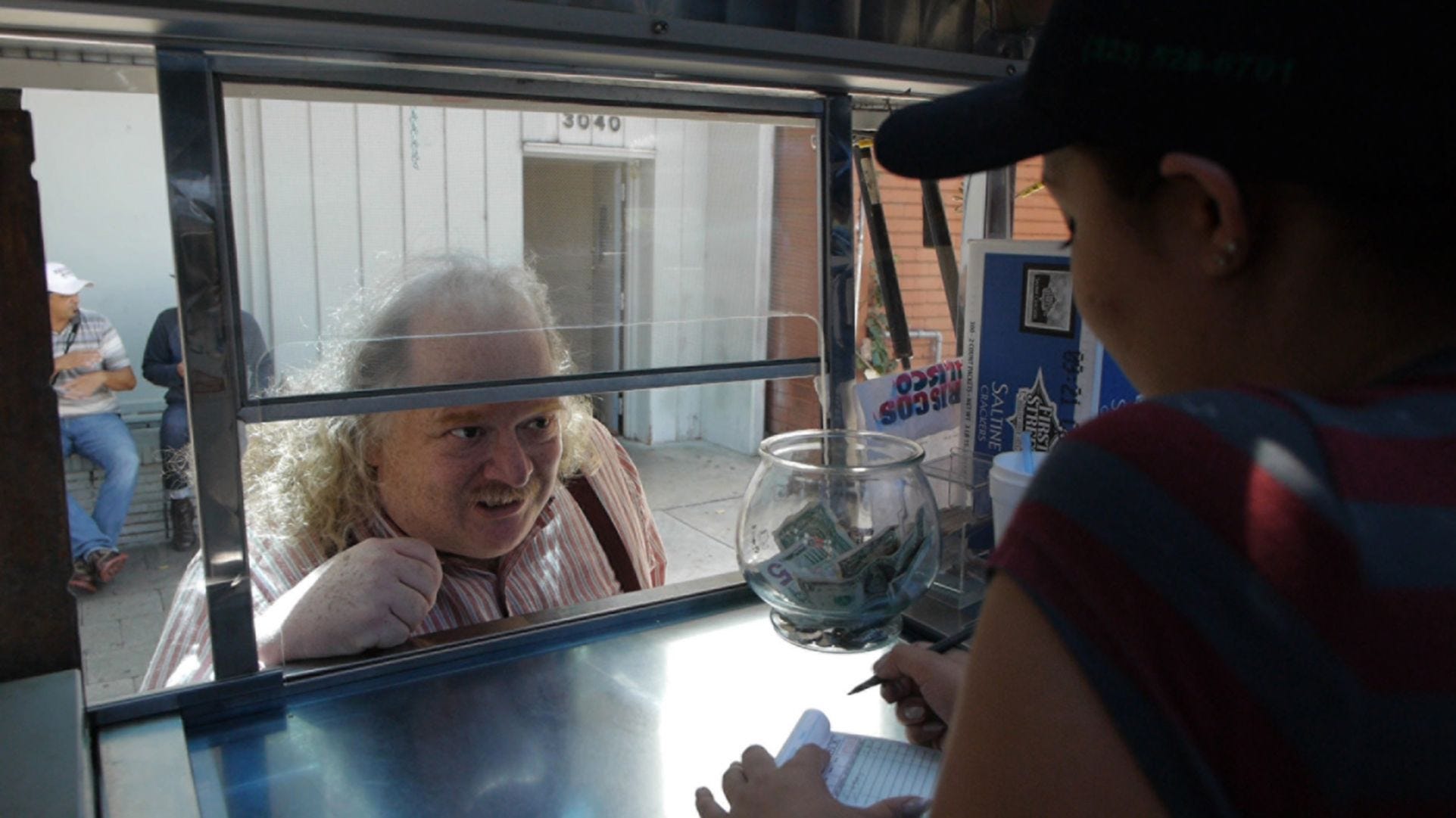
The late Jonathan Gold, a Los Angeles native who won a Pulitzer for writing brilliantly and obsessively about his home town’s culinary culture, observed that much of the city’s best food was produced in service of self-contained immigrant communities. The kinds of places he championed, he noted in “City of Gold,” the 2015 documentary about his life and career, “are not cooking for tourists and they’re not cooking for the newspaper critic and they’re not cooking for the glory of it—they’re cooking because they’re fulfilling a specific need that their community has.”
As Gold well understood, the fact that L.A.’s Korean dumpling shops, Armenian grocery stores, Thai lunch counters, and Salvadoran pupuserías are open to curious outsiders is one of the great privileges of living here. A year into my life in L.A., I can chart my infatuation with the city in meals: a simple but spectacular banh mi from My Dung, a bare-bones shop in Chinatown; a royal Manchu spread, including exquisite fried shrimp and sautéed chayote leaves, at the elegant Bistro Na’s, next door to a Planet Fitness in the San Gabriel Valley; a steaming bowl of higaditos—a Oaxacan chicken-and-egg soup—at Comedor Tenchita, a collection of folding tables in the back yard of a bungalow on a sleepy residential block in Mid-City.
Jonathan Gold would never have written “The Fibre Fad” because, as “City of Gold,” a documentary worth watching because it features mostly Gold and very little of a bunch of annoying talking heads telling you how important he is, makes clear, he’s just one of the best critics who’s ever written about anything. Watching him drive around L.A. in his hilariously awful green pickup truck and say “that place has great asada, that place is named Pho King which they really should have thought about more but it has decent food…” and then stop in random strip malls and describe the increased variety of mole available after the migration of Central Americans to L.A. in the 80’s because of civil wars while eating Szechuan food is totally worth it.

“City of Gold” also includes a lot of scenes of L.A. in the early 2010’s, montages where Gold simply reads his best articles, and those are nearly as good as hearing him talk extemporaneously. Gold can create a beautiful narrative about any restaurant with economy and grace. I’ll never eat at these places, and it doesn’t matter.
However, he doesn’t read from my favorite restaurant review of his, featuring Robert Sietsema, who still writes (very fun!) reviews of restaurants in New York City on Substack to this day. It’s kind of obvious why this review isn’t in the film: Gold takes the New Yorker Sietsema nearly three hours away from Los Angeles, to the agricultural town of Bakersfield, where he reviews seven places in the town about as many paragraphs. I can’t quote it. Go read it. Ok, fine, I’ll quote one part:
…We found ourselves at the Pyrenees bar in East Bakersfield, knocking back our second Picon punch and watching the old Basque guys roughhousing down at the other end of the bar.
If you’ve never had a Picon punch, which is more or less the official tipple of Basque Bakersfield, it can seem a little like a girlie drink, a cocktail of brandy, maraschino syrup, and a healthy slug of a bitter Algerian liqueur called Amer Picon. If you get the right bartender, it even comes with a cherry in it. But if you linger at the Pyrenees long enough, rest assured: You will see a burly oil worker thrust out his gut, snarling, “Gimme Pi-cahhhn.” Picon punch goes down smoothly, but gnaws at your brain for hours. Sietsema was slammed hard by the drink, and woozily asked the bartender, who could have passed for a young Betty Page by the third Picon punch, if she’d consider taking him home with her.
She sneered at the lameness of Sietsema’s come-on, a world-class sneer, a sneer that would have served her well behind any bar in Silver Lake or on the Lower East Side, and the two of us were as smitten as any two drunk, married guys could ever be at 3 in the afternoon.
“You two are from out of town,” she said delicately. “Tourists.” She flicked the hair out of her eyes.
“You brought a wrapped loaf in with you, so I know you’ve already been to the Pyrenees Bakery. You probably stopped in at Luigi’s — for what? A plate of beans? Spaghetti with sauce? — but you had your main lunch at one of the Basque restaurants. My guess is Wool Grower’s, because you two are too pathetic to have gotten up in time for noon lunch at one of the better places. You have a bagful of Dewar’s peanut chews in the car. After this, you’re going over to the Alley Cat, because the place is for losers, because you think the neon and the Hirschfeld mural are ‘cool.’ Tonight for dinner, you’re going to . . . not here, because otherwise you wouldn’t be here now . . . to the Noriega. Definitely the Noriega. And I don’t blame you for going there: Tuesday is prime-rib night.”
On her way back to the regulars, she turned in our direction, pulled up her blouse, and flashed us. It was a friendly gesture, and we appreciated it. Even if she’d had us mostly dead to rights.
Did this even happen, or did Gold dream it in some drunken haze with his fellow food critic? Gold contains multitudes, but one thing he certainly does not contain, in his car full of bread and candy bars and his body full of Picon punch, is fibre.
Have a great weekend!
I’m going to follow John Pistelli here and bury this in a footnote, so reader beware. It may be (probably is) true that nearly everything is better in Minnesota than it is in my (adopted) state, but I’ve been hearing that for 19 years, since I went to college in Iowa with a bunch of Minnesotans, and I don’t need to hear it from someone who’s never lived there! It’s just spon-con for “Minnesota Nice,” a concept I am warily willing to endorse through December 31, 2026 in compensation for the invasion of the state by the Gestapo, but on January 1, 2027 I will revert to the stance that began upon my visit to Minneapolis in summer 2010: it is a properly rated city, not an underrated one, as Minnesotans (especially the utterly infuriating Tim Walz) are constantly trying to push on the rest of the country! The winters are terrible, the summers are mosquito-ridden, the art and culture are far inferior to Chicago’s, and the only reason Minnesotans are obsessed with how terrible Iowa, the Dakotas, etc. are is because they know that Chicago is a superior city to their own.
I drink way less than I used to but I find performative non-drinking to be nearly as weird as trying to force someone who’s trying not to drink to drink with you.
Prunes and black coffee, both of which are mentioned in the article. I am now too old to eat what I want all the time without paying attention to my fiber intake, but I don’t OPTIMIZE for it, I just buy prunes every time I go to the grocery store, which prompts me to eat the ones that are already open in the pantry. This is the first and last time I’ll talk about my colon on the internet—I’m not ashamed of it, it’s just not that interesting!
This was GREAT, most enjoyable Substack longread in ages (I say as someone in the sweet spot of "have read Buddenbrooks in the last 3 years" and "going to NYC next week and trying to see if I can fit in a side trip to Jersey City for goat curry")
Haha dude I also love reading the New Yorker restaurant reviews despite living on the other side of the country and not really being a "restaurant guy" (well I suppose I am but as you know more for atmosphere reasons than food ones and not really interested in the hot new whatever). I read Helen Rosner though. I just think she is great w/ descriptions, any writer can learn from her, and I do like to cook so sometimes it kickstarts an inspiration. Agree whenever they write a trend piece based on five tiktoks it's unbearable.